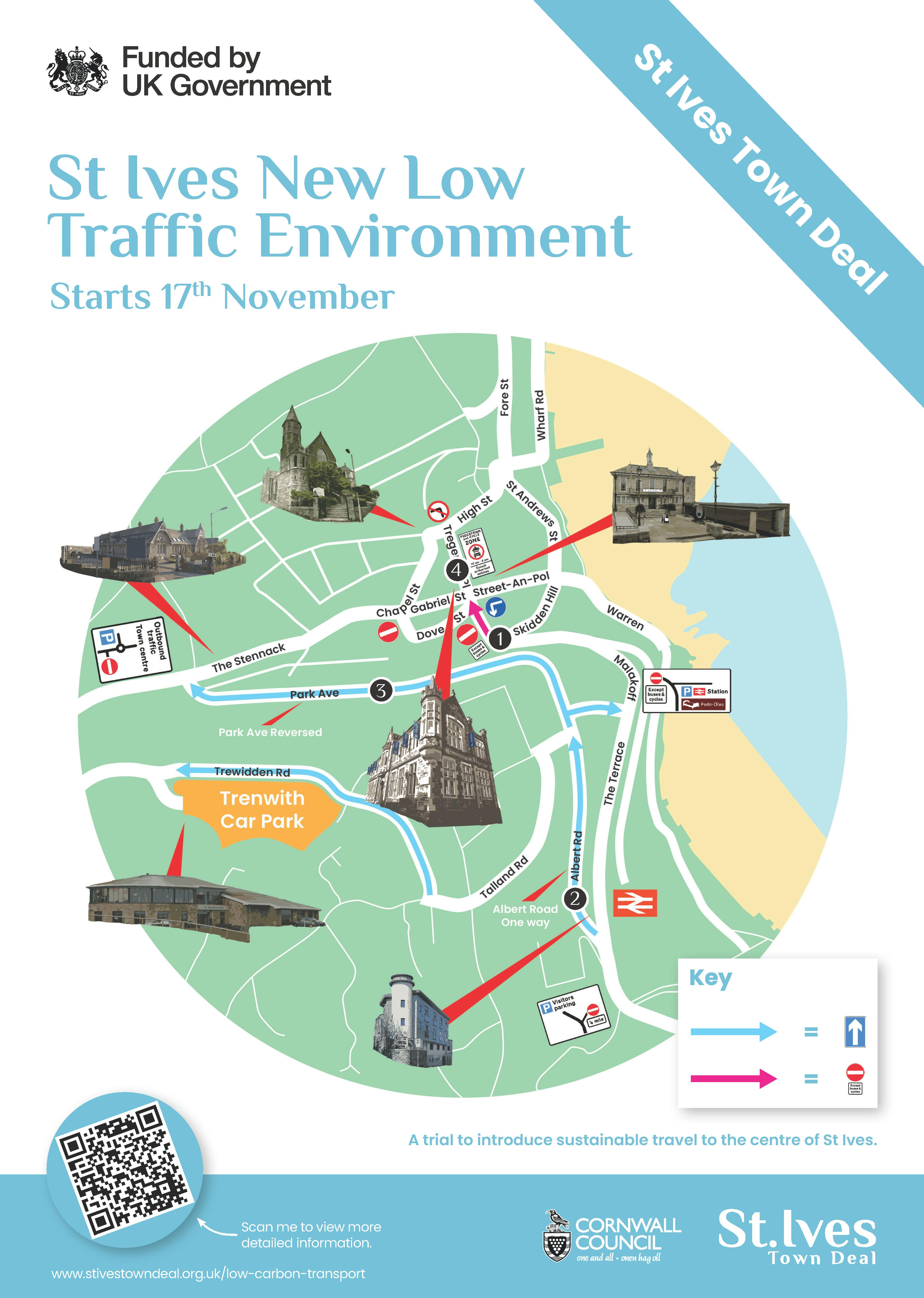
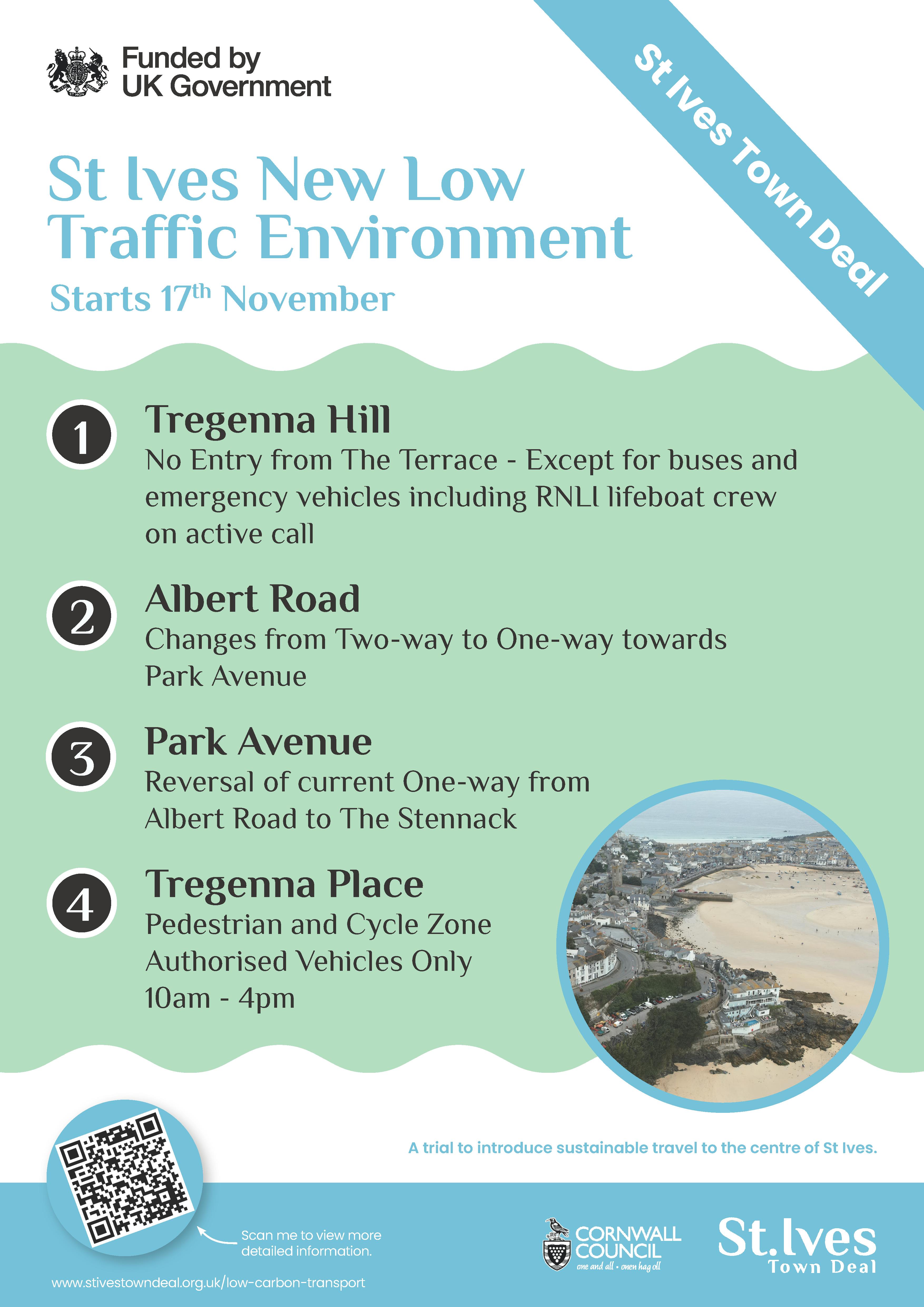
St Ives Town Deal - Experimental Traffic Order
Changes to the current road layout on Tregenna Hill in the centre of St Ives are to be trialled as part of an Experimental Traffic Order (ETRO).
The survey is now open for responses.
What are we consulting on?
The current amount of traffic movements on Tregenna Hill result in numerous daily conflicts between vehicles and pedestrians, impacting on everyone’s safety and user experience.
The aim of the trial, which will be implemented via an ‘Experimental Traffic Regulation Order’ (ETRO), is to improve general traffic flow resulting in a safer space for all users in and around Library Corner. The changes will also support the broader aims of the Town Deal Transport Strategy and the creation of a Low Traffic Environment in the town centre.
From 17th November only buses, cyclists and emergency services (including lifeboat crews on active duty) will be permitted to drive northbound down Tregenna Hill from The Terrace. All traffic will still be able to drive southbound up Tregenna Hill.
The general removal of northbound traffic down Tregenna Hill will reduce the current delays, impact and congestion created by vehicles having to navigate past each other in a highly constrained space. The changes will also make it easier for buses, lorries and other large vehicles to get around the narrow points and corners along the route.
Although supported by the wider transport strategy measures, this trial alone is unlikely to reduce the overall amount of traffic at Library Corner. However, the imposed restrictions on Tregenna Hill mean that general traffic will only be flowing in one direction, reducing the opportunity for conflict to occur, creating a more controlled environment.
New signs will be installed at key roads and junctions informing drivers of the changes and new restrictions and providing details of alternative routes into and out of St Ives. During at least the first week of the trial, traffic marshals will also be in place at key locations to help support drivers who may be unaware or unsure of the change.
Other measures being introduced as part of this trial include making Albert Road one-way inbound, improving the flow of traffic and reducing traffic congestion and delays, introducing an entry restriction on the western end of Dove Street and a mandatory left turn at Street-an-pol. There will also be no right turn at the bottom of Bedford Road.
The direction of the existing one-way at Park Avenue will also be reversed, allowing inbound traffic only towards Bullans Lane and the Doctors surgery. This will help to keep traffic moving along this route, reducing the numbers of queuing stationary vehicles.
This change is intended to deliver several specific benefits for residents of Park Avenue including:
- Potential reduction in the number of vehicles using Park Avenue
- Reduction or removal of the local buses, a long-standing aspiration of residents
- Create opportunity to consider further restriction of larger vehicles by decreasing the current weight restriction
The change to the traffic flow along Park Avenue will also help to reduce a potential network pressure up over the Burrows to the Stennack, past Trenwith Car Park and Leisure Centre, as a consequence of the proposed trial changes.
By providing a route for local traffic, the reversal will help maintain a balance of vehicles on the road network in this part of the town. This will be closely monitored throughout the trial.
Why an ETRO?
The use of an ETRO means that Cornwall Council as Highways Authority can make modifications throughout the trial period, responding agilely to specific issues or concerns that are observed.
This will provide a greater chance for success, with both community feedback and engineer analysis shaping the ultimate decision making as to whether the trialled changes are made permanent or not.
The ETRO has been developed by Cornwall Council in partnership with St Ives Town Deal Board, with technical expertise provided by Cormac. Engagement with key stakeholders, including St Ives Town Council, transport operators and providers and emergency services, has influenced the development of the new road layout which is now being trialled.
The trial is being funded through the St Ives Low Carbon Transport Strategy and will remain in place for at least six months but could extend up to 18 months before a final decision is made.
To view details of the scheme & the legal Experimental Traffic Order, please visit our Appyway Platform.
How can I respond to this consultation?
To provide us with feedback about these proposals, please complete the Feedback Form below.
Alternatively, you can email Cormac Infrastructure Design at traffic@cormacltd.co.uk or post a response to Infrastructure Design Group, Cormac Consultancy, Radnor Road, Scorrier, Redruth, TR16 5EH. When emailing or responding by post, please quote the following scheme reference Infra24-159.
All responses received will be given due consideration. Following the closure of the consultation period and subsequent scheme assessment process, we will provide you with an update on both the result of this process and, if applicable, the anticipated timescales for any associated works.
We regret that if you choose not to provide your address or withdraw your personal information before the completion of the scheme assessment process, we will be unable to consider your response in regard to a particular aspect of the scheme. Nonetheless, any points made will still be considered as general comments. If neither a postal address or email address is provided, we will also be unable to keep you updated on the scheme's progress.
Update: Additional information and discounted options detail:
Case for Change
There has long been conflict between vehicles and pedestrians trying to navigate the narrow streets of St Ives, particularly in the peak summer season. To help address this growing problem it was agreed to develop a new transport strategy which would to help reduce traffic congestion and parking demand in the town centre, enhance public transport options and accessibility, improve air quality and health outcomes for residents and visitors and support local businesses by creating a more attractive and vibrant town as part of the St Ives Town Deal programme.
The development of the Low Carbon Transport Strategy, led by the Town Deal Board Transport Subgroup which includes elected members and representatives of local organisations, identified reducing the daily conflicts between vehicles and pedestrians as a key priority, with the aim of creating a safer highway environment for all.
Reflecting on the positive impact of the Town Council scheme implemented during COVID, which saw restrictions on vehicles driving through core areas of the town such as Wharf Road and Fore Street at specified times, the group began by considering a range of measures to create a Low Traffic Environment (LTE).
This included looking specifically at measures to reduce congestion and improve safety in and around Library Corner and Tregenna Hill. This principal traffic route experiences extreme pressure, especially in the summer months, making it difficult for residents and visitors to navigate safely whether travelling by foot, by bike or by motor vehicle. The site currently has the 6th highest number of collisions in the county.
Previous community consultations have identified this area as one of the main highway concerns for the local community, but it is also one of the more complex environments to implement an effective solution which maintains access for everyone who needs it.
Highway engineers on behalf of Cornwall Council worked in partnership with the Town Deal Board and its Sub Group to develop potential options.
These include:
Full one-way system and rising bollard - Discounted
This option sought to replicate the benefits of the COVID scheme whilst also controlling vehicles on Tregenna Hill.
However, a detailed assessment of the technical and management operations of a rising bollard revealed that successfully implementing such a measure would present a significant challenge. A full one-way solution on Tregenna Hill would also have the potential to significantly impact access for buses, cycles and emergency services including the RNLI.
These challenges, coupled with a lack of support from the local community, led to the decision to discount this option.
Alternating Traffic Signals - Discounted
This traditional form of traffic management would have seen traffic lights placed principally on The Terrace and Gabriel Street, allowing two-way traffic to alternate in a controlled environment. Although a technically tried and tested solution, the localised constraints and traffic volumes presented several challenges.
Assessments by highway engineers concluded that the technical challenges of this option could create greater levels of traffic congestion within the town.
Traffic Signal Controlled Bus Gate - Discounted
This option generally aligns with the currently implemented traffic management changes but would incorporate further controls through the use of traffic lights.
Although this system was assessed as being likely to perform better than the Alternating Traffic Signals option above, highway engineers still had serious reservations on how it would perform and identified a number of localised technical complications that would need to be overcome. These included ensuring access for emergency services, including RNLI crews, the diversion of cyclists, ensuring that adjoining streets could be incorporated into the system and control of waiting and loading in the vicinity.
Having considered all these remaining uncertainties, the investment costs and the potential disruption to the local community of implementing the scheme, this option was also discounted.
Sign-Only Bus Gate – Selected Option
This option, which includes the principles of a Bus Gate using a sign-only approach instead of traffic lights, was selected following a detailed assessment of all the potential challenges and benefits.
Although it reduces the control over motor vehicles, the approach removes some of the technical and operational challenges identified in the previous option. As well as being more cost effective and least disruptive to implement, it can also be reversed with relative ease if it is considered to have a detrimental impact upon the town.
It can also be implemented by Cornwall Council via an ‘Experimental Traffic Regulation Order’ (ETRO), allowing the scheme to be trialled before any decision is made on a permanent scheme.
Park Avenue Reversal of One-Way
In conjunction with the selected option, two scenarios for Park Avenue were considered.
Having considered the pros and cons for both options, members of the Sub Group and the Town Deal Board concluded that the ETRO should lead with Park Avenue being reversed.
Below are a summary of the pro and cons which were considered during the process..
Pros
- Provides a route for local traffic to access the town - rather than all traffic having to enter at the top of The Stennack
- Reduction or removal of the local buses, a long-standing aspiration of residents
- Create an opportunity to consider further restriction of larger vehicles by decreasing the current weight restriction
- Allows Albert Road to become one-way – creating a one-way route into town
Cons
- Unlikely to reduce traffic volume around Library Corner – however the imposed restrictions on Tregenna Hill mean that general traffic will only be flowing in one direction, reducing the opportunity for conflict to occur, creating a more controlled environment.
- Removes access to Park Ave car park from the Stennack
Tregenna Place Access Restriction
Following the previous decision by the Town Deal Board to discount a proposal to use rising bollards to control access to the town centre, highway engineers considered a number of potential measures to help reduce the dominance of vehicles and potential conflict with pedestrians and cyclists in the town, including Wharf Road and Fore Street.
As Tregenna Place is the primary access gateway into the town centre, it was agreed that any restrictions would need to be implemented at this location. A proposal to introduce seasonal restrictions during the peak summer season was discounted as it was felt that this could create confusion. The reversal of Park Avenue also meant that any restriction implemented on The Stennack would effectively prevent traffic from leaving the town.
It is vital to ensure that any restriction works for the local community and ensure that the town can remain livable and operable. To achieve this it was agreed that a 10am – 4pm Pedestrian & Cycle Zone with access to authorized vehicles only would be introduced as part of the ETRO.
This does not mean that all vehicles are banned from driving through the Zone between these hours. People who need to access their home or business, including holiday accommodation, can still do so between 10 am and 4 pm provided they are driving directly to the premises. This includes being able to pick up or drop off passengers or luggage.
While people will still be able to access the Zone as explained above, the restrictions are expected to lead to a reduction in unnecessary or avoidable access.
Are the Changes Safe?
Tregenna Hill is ranked 6th in collisions sites in the county and therefore has a high-risk baseline. While no road can ever be considered totally safe as there are too many variables, the new road layout has been safety assessed with the foreseeable safety implications identified. A team of highways professionals have rated the measures in terms of the risk they present and appraised them against a recognised standard.
Mitigations have been considered to reduce the risk profile and implemented where reasonably possible to do so and will be continually reviewed throughout the 12-month trial period. The safe performance of all traffic management changes made as part of the ETRO are core to the monitoring and evaluation, having significance on any decision making surrounding the permanency of the changes.
Has Traffic Modelling been carried out?
Localised traffic modelling and junction analysis was carried out to aid the development of the traffic management changes for the town. However, such approach has recognised limitations and is only intended as a guide. While some ‘light touch’ strategic modelling was carried out, it was considered more appropriate to invest in the implementation of the ETRO and monitor the real-world impact and performance rather than engage in detailed theoretical modelling.
What is the cost of the ETRO changes?
The implementation of the ETRO traffic management changes have cost in the region of £100,000. Although a significant investment, a strategic traffic modelling exercise alone would have cost at least double this amount. All signs and lines have been installed to a permanent specification meaning that if the decision is to maintain the changes post-trial, no further expense would be required. Conversely if the changes are to be reversed, the approach has still avoided considerable costs, with the signs and posts likely to be in a useable condition for redeployment elsewhere.
Are the changes enforceable?
Yes, the changes are enforceable as they have been implemented via Traffic Regulation Orders which were made subject to a legal order under the Road Traffic Regulation Act 1984.
Cornwall Council as Highways Authority has worked in partnership with the St Ives Town Deal Board and the Sub Group to bring about this change for the benefit of the community and, to support this aim, has adopted an education-first approach. However we will continue to monitor compliance through the connected network of smart traffic sensors and consider action as necessary if non-compliance impacts performance or there is a need driven by safety
Why are there not more signs?
The number, size and content of traffic signs are controlled by the Traffic Signs Regulations and General Directions legislation, limiting what can be installed on a highway. As part of the Monitoring and Evaluation programme we will consider continual improvements to the road signage deployed in support of the ETRO and take reasonable action where identified.
Why have these changes been implemented now and before some of the other planned changes in the Town?
The ETRO has been intentionally launched in November at the quietest time of the year to help residents and businesses to adjust to the changes. We are, however, acutely aware that the impact of the changes may be materially different through the summer when visitor numbers are at their greatest. This is why the trial will be remaining in place for 12 months, rather than the minimum 6 months period. With traffic expected to increase over Christmas and the New Year we will be able to gain greater insight and understanding of how the changes might perform over the summer peak, allowing time for any adaptions to be made.
The ETRO has been implemented before the additional traffic schemes have been completed as the outcomes of the trialled changes could reasonably have some effect on the final design details of additional schemes.
However, the absence of such other schemes has not been identified as materially likely to affect the safety or initial performance of the implemented traffic management changes as part of the ETRO. If the decision, based on the monitoring & evaluation of the ETRO performance, is to make the traffic management change permanent, any wider/additional schemes to then be delivered are considered to only enhance the outcome.
Programming additional schemes following the ETRO trial period will help to reduce the likelihood of abortive works, mitigating additional costs and the disruption of further highway works on the St Ives community that are reasonably preventable.