We use cookies to ensure our site functions properly and to store limited information about your usage. You may give or withdraw consent at any time. To find out more, read our privacy policy and cookie policy.
Manage Cookies
A cookie is information stored on your computer by a website you visit. Cookies often store your settings for a website, such as your preferred language or location. This allows the site to present you with information customized to fit your needs. As per the GDPR law, companies need to get your explicit approval to collect your data. Some of these cookies are ‘strictly necessary’ to provide the basic functions of the website and can not be turned off, while others if present, have the option of being turned off. Learn more about our Privacy and Cookie policies. These can be managed also from our cookie policy page.
Strictly necessary cookies(always on):
Necessary for enabling core functionality. The website cannot function properly without these cookies. This cannot be turned off. e.g. Sign in, Language
Analytics cookies:
Analytical cookies help us to analyse user behaviour, mainly to see if the users are able to find and act on things that they are looking for. They allow us to recognise and count the number of visitors and to see how visitors move around our website when they are using it. Tools used: Google Analytics
Share Meaningful Co-production on FacebookShare Meaningful Co-production on X (formerly Twitter)Share Meaningful Co-production on LinkedinEmail Meaningful Co-production link
Ladder of Co-Production
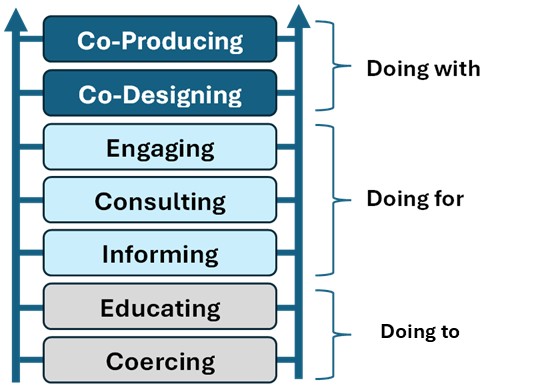
The Co-production Ladder is a framework. It is used to describe different levels of involvement and power-sharing between Cornwall Council and communities. It helps visualise how collaboration can range from minimal involvement to full partnership.
Phrase
What it means
Example
Coercing
A local housing provider decides citizens have to use a service or do something without really understanding what they want or need.
A housing provider moves all housing repair requests to an online portal and stops accepting phone calls or in-person requests. Residents without internet access or digital skills have no choice but to use the online system. Their needs weren’t considered.
Educating
The council explains the benefits of its services and why they matter. It may try to encourage residents to change their behaviour.
The council runs workshops to educate residents why saving energy is important and gives tips on how to reduce energy use at home.
Informing
The council communicates to people about its services and explains how they work.
A newsletter is sent out to residents to update them on activities the council has changed recently.
Consulting
The council asks residents and local groups to share their views by taking part in surveys or meetings about plans or issues.
The council shares three different plans for improving local parks and asks residents to vote for the one they prefer.
Engaging
The council regularly gives citizens and community groups chances to share their views in different ways. Their input can help shape some decisions.
Residents in Penzance are encouraged to take part in a survey. The survey is about future investment in coastal protection and flood prevention measures.
Co-designing
Residents and local groups help design council services and projects. They can influence decisions but usually don’t help deliver them.
The council runs workshops where people help design a new recycling scheme, and their ideas are included in the final plan.
Co-production
Residents work with the council and partners from start to finish. Decisions are shared, and citizens help design and deliver services.
The council teams up with resident groups to redesign local parks, involving them in every stage - from planning to building and ongoing maintenance.
Meaningful v.s. Tokenistic Co-production
As shown in the Ladder of Involvement, there are different ways the council can work with people. True co-production sits at the top of this ladder, representing the highest level of collaboration. It’s important to distinguish genuine co-production from tokenistic efforts. They may look collaborative but fall short in practice.
Tokenistic co-production happens. Mainly, when consultations and engagements are presented as full co-production. This often occurs when citizens input is collected to meet a requirement but is not meaningfully used in decision-making.
To ensure co-production is genuine and effective, we must critically look at the depth and quality of collaboration.
"I" statements to ensure meaningful co-production
To check if your co-production work is genuine, ask yourself:
Am I treated as an equal partner?
Do I have a say in decisions from the start?
Are my skills and experience valued?
Do I have access to all the information I need?
Am I supported to participate fully?
Is the process accessible and inclusive?
Are my contributions making a real difference?
Is there a commitment to long-term change?
The more “yes” answers you have, the closer you are to true, meaningful co-production. The more “no” answers, the more tokenistic it is.
Offering Choice Matters
True co-production should be the goal for some projects. It’s okay to offer a variety of involvement options from across the Ladder of Involvement. This gives people choice in how they participate, recognising that not everyone wants or is able to engage at the same level.
Key Reminder
Co-production is not a tick-box exercise. It requires genuine commitment and effort from all parties to create meaningful change. If you’re unsure about something or think policies need explaining more clearly, feel empowered to speak up. Your lived experience makes you an expert in the room.
Ladder of Co-Production
The Co-production Ladder is a framework. It is used to describe different levels of involvement and power-sharing between Cornwall Council and communities. It helps visualise how collaboration can range from minimal involvement to full partnership.
Phrase
What it means
Example
Coercing
A local housing provider decides citizens have to use a service or do something without really understanding what they want or need.
A housing provider moves all housing repair requests to an online portal and stops accepting phone calls or in-person requests. Residents without internet access or digital skills have no choice but to use the online system. Their needs weren’t considered.
Educating
The council explains the benefits of its services and why they matter. It may try to encourage residents to change their behaviour.
The council runs workshops to educate residents why saving energy is important and gives tips on how to reduce energy use at home.
Informing
The council communicates to people about its services and explains how they work.
A newsletter is sent out to residents to update them on activities the council has changed recently.
Consulting
The council asks residents and local groups to share their views by taking part in surveys or meetings about plans or issues.
The council shares three different plans for improving local parks and asks residents to vote for the one they prefer.
Engaging
The council regularly gives citizens and community groups chances to share their views in different ways. Their input can help shape some decisions.
Residents in Penzance are encouraged to take part in a survey. The survey is about future investment in coastal protection and flood prevention measures.
Co-designing
Residents and local groups help design council services and projects. They can influence decisions but usually don’t help deliver them.
The council runs workshops where people help design a new recycling scheme, and their ideas are included in the final plan.
Co-production
Residents work with the council and partners from start to finish. Decisions are shared, and citizens help design and deliver services.
The council teams up with resident groups to redesign local parks, involving them in every stage - from planning to building and ongoing maintenance.
Meaningful v.s. Tokenistic Co-production
As shown in the Ladder of Involvement, there are different ways the council can work with people. True co-production sits at the top of this ladder, representing the highest level of collaboration. It’s important to distinguish genuine co-production from tokenistic efforts. They may look collaborative but fall short in practice.
Tokenistic co-production happens. Mainly, when consultations and engagements are presented as full co-production. This often occurs when citizens input is collected to meet a requirement but is not meaningfully used in decision-making.
To ensure co-production is genuine and effective, we must critically look at the depth and quality of collaboration.
"I" statements to ensure meaningful co-production
To check if your co-production work is genuine, ask yourself:
Am I treated as an equal partner?
Do I have a say in decisions from the start?
Are my skills and experience valued?
Do I have access to all the information I need?
Am I supported to participate fully?
Is the process accessible and inclusive?
Are my contributions making a real difference?
Is there a commitment to long-term change?
The more “yes” answers you have, the closer you are to true, meaningful co-production. The more “no” answers, the more tokenistic it is.
Offering Choice Matters
True co-production should be the goal for some projects. It’s okay to offer a variety of involvement options from across the Ladder of Involvement. This gives people choice in how they participate, recognising that not everyone wants or is able to engage at the same level.
Key Reminder
Co-production is not a tick-box exercise. It requires genuine commitment and effort from all parties to create meaningful change. If you’re unsure about something or think policies need explaining more clearly, feel empowered to speak up. Your lived experience makes you an expert in the room.